 listicle
How Do You Choose Frames for Your Face Shape?
Last Updated: October 25, 2026
Quick Summary
To choose frames face shape, first identify your category, round, square, oval, heart-shaped, or long, by measuring your forehead, cheekbones, jawline, and face length. Then select frame styles that contrast with or balance your natural proportions: angular frames for round faces, curved frames for square faces, and proportional frames for oval faces.
- Measure four widths and face length from a front-facing photo to determine your dominant and secondary face shape.
- Round faces need rectangular or geometric frames wider than they are tall to add definition and visual length.
- Square and heart-shaped faces benefit from round, oval, or curved frames that soften angular features.
- Oval faces are versatile and work with nearly any frame style based on personal preference.
- Frame width should be proportional to your cheekbone width, typically your widest facial measurement.
Table of Contents
- 1. How to Determine Your Face Shape
- 2. Best Glasses for Round Faces
- 3. Best Glasses for Oval Faces
- 4. Frames for Square and Heart-Shaped Faces
- 5. Eyeglass Frame Size Guide: Width, Bridge, and Fit
- 6. Balancing Proportions: Frame Shape and Facial Features
- 7. Personal Style, Skin Tone, and Prescription Considerations
- Schedule Your Frame Fitting at Corner Optical
- Frequently Asked Questions
1. How to Determine Your Face Shape
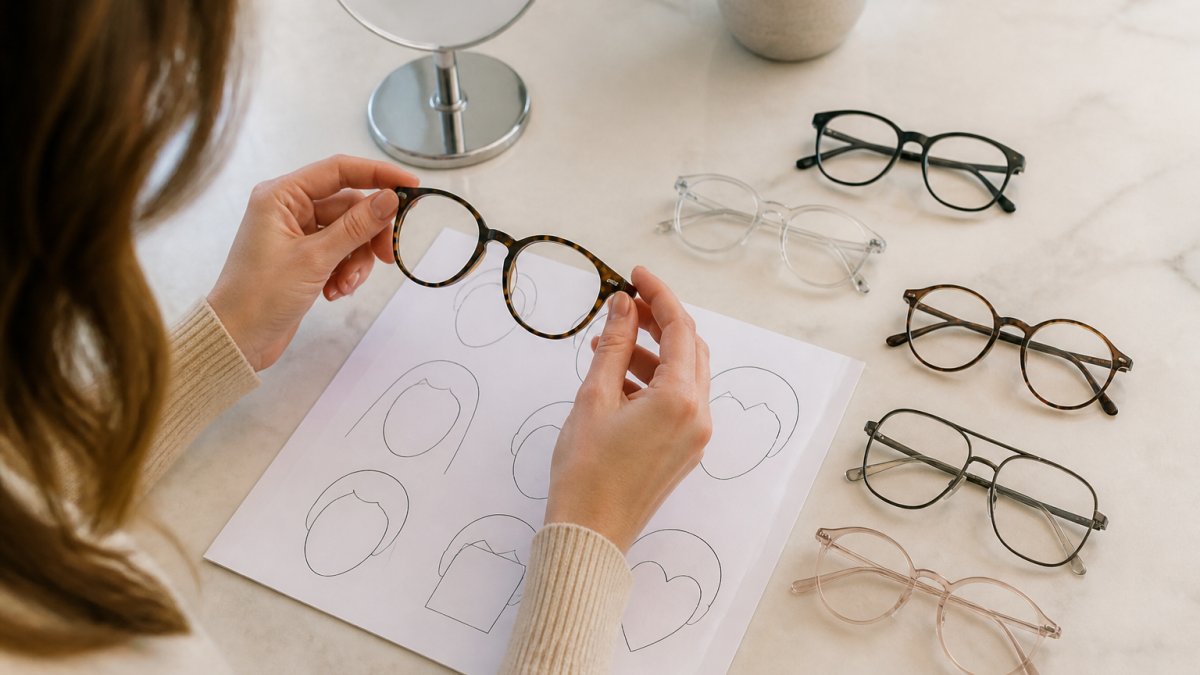
When you choose frames face shape matters, start by identifying your category: round, square, oval, heart-shaped, or long/oblong. Each has distinct proportions that determine which frames complement your features best.
Most people don't fall neatly into one category, so use this four-step process and write down each number to compare them.
Step 1: Take a front-facing photo. Stand in even light, look straight at the camera, and pull your hair back so your forehead, cheekbones, jawline, and chin are visible.
Step 2: Measure four widths and one length. With a soft tape measure or a ruler held against the photo, record:
- Forehead width at its widest point, usually just below the hairline
- Cheekbone width at the most prominent point
- Jawline width at the widest point before the chin curves
- Face length from hairline to the bottom of the chin
Step 3: Compare the numbers, not the impression. The widest measurement and the length-to-width ratio do most of the work:
- If forehead, cheekbones, and jawline are within roughly a quarter inch of each other and the chin is rounded, the shape is round.
- If those three widths are similar but the jawline is angular and the chin is squared, the shape is square.
- If face length is clearly greater than cheekbone width and the jawline tapers gently, the shape is oval.
- If the forehead and cheekbones are the widest points and the jawline narrows sharply to a pointed chin, the shape is heart-shaped.
- If face length is noticeably greater than width and the forehead and jawline are narrow, the shape is long or oblong.
A few practical notes: photo measurements are approximate, so treat the result as a starting point. Facial asymmetry is normal and doesn't change your category. Age shifts apparent proportions, so recheck every few years.

For the most accurate assessment, visit Corner Optical for comprehensive eye care, eye exams, and family vision services. Our optometrists can help you identify your exact face shape and recommend frames that work with your natural features.
2. Best Glasses for Round Faces
Round faces have soft, curved features with cheekbones and chin roughly equal in width to the forehead. The goal is to add definition and create the illusion of a longer face, so angular and geometric frames work best because they contrast with your natural curves.
Look for frames wider than they are tall, rectangular, square, or geometric, to add visual length and balance width. Avoid round or oval frames, which echo your curves and make your face appear rounder. Strong brow lines and angular details also add structure.
Frames that sit slightly above your cheekbones and are proportional to your face width work best. Oversized frames overwhelm a round face; too-narrow frames look out of proportion. Browline styles with bold upper frames also create helpful angles.

When you discover our curated collection of renowned and independent eyewear brands at Corner Optical, you'll find rectangular and geometric styles specifically chosen to complement round face shapes. Our team can show you how different frame widths and heights change your appearance.
3. Best Glasses for Oval Faces
Oval faces are well-proportioned, with a gently rounded jawline and a forehead slightly narrower than the cheekbones. This balanced shape works with nearly any frame style, making oval faces the most versatile.
You can choose frames based on personal style rather than correcting proportions. Rectangular frames add definition, round or oval frames soften your appearance, cat-eye frames emphasize your cheekbones, and browline styles draw attention to your eyes.
Frame width should be proportional to your face width. Since your face is already balanced, experiment with bolder styles, vintage shapes, or trendy designs, just ensure the frame width aligns with your widest part, typically your cheekbones.
Prescription considerations matter here too. If you have a strong prescription, thinner frames may look better than heavy, chunky styles. Anti-reflective coatings help minimize the appearance of thick lenses behind the glass.
4. Frames for Square and Heart-Shaped Faces
Square faces have a strong jawline roughly as wide as the forehead, with angular features throughout. To soften this, choose round, oval, or curved frames. Avoid frames that emphasize angles or match your face's geometry exactly.
Browline and clubmaster styles work well for square faces because they add softness while maintaining some structure. Round frames create contrast and soften the overall look. Frame width should be proportional to your face width, and slightly narrower frames can help elongate your appearance.
Heart-shaped faces are wider at the forehead and cheekbones, then taper to a pointed chin. Balance the wider upper face and draw attention from the narrow chin with bottom-heavy frames like browline or clubmaster styles. Avoid frames that are too narrow or delicate, which emphasize the pointed chin.
For heart-shaped faces, frame width is especially important. Frames that are proportional to your cheekbone width create balance. Lighter-colored or transparent frames can also help soften the overall appearance.
5. Eyeglass Frame Size Guide: Width, Bridge, and Fit
Four measurements determine whether your glasses fit comfortably and stay in place: frame width, bridge width, lens width, and temple length. Most frames print these on the inside of the temple arm, usually as 52-18-140, a 52mm lens width, 18mm bridge, and 140mm temple.
Frame width. Frame width is the total width of the frame when laid flat, measured in millimeters. Frames that are too wide slip down the nose and sit past the temples; frames that are too narrow press against the sides of the head and can cause headaches. (Source: the importance of regular eye exams)
Bridge width. The bridge sits on the nose and typically ranges from 14mm to 24mm. A proper bridge fit means the frame rests without pinching or sliding.
Lens width and frame depth. Larger lenses give a wider field of view but add weight and thickness with strong prescriptions.
Temple length. Temple length determines how the frame sits on your ears and head and ranges from about 120mm to 150mm. The temple should reach the ear and bend down behind it without pressing or sliding off.
Translate your face measurement into a frame spec. Start with your cheekbone width and add roughly 2-4mm of clearance on each side.
Fit checks to run before you buy. Look straight ahead: your eyes should sit near the horizontal center of each lens, and the top of the frame should roughly follow your brow line without covering it.
Adjustments matter as much as measurements. Most frames can be adjusted at the bridge, temples, and nose pads. A frame that fits imperfectly off the shelf can often be made comfortable by an optician.
Getting professionally fitted ensures your glasses stay in place and remain comfortable throughout the day.
6. Balancing Proportions: Frame Shape and Facial Features
How you choose frames face shape and your facial features together determine how well your glasses complement your appearance. Round, oval, rectangular, square, geometric, and cat-eye styles each create a different visual effect.
Angular frames like rectangular and square styles add definition and create contrast. They work best for round or soft faces that benefit from added structure.
Strong cheekbones are enhanced by frames that sit just above them. A prominent jawline is balanced by frames that don't emphasize the chin area. A wide forehead benefits from frames that draw attention downward, like browline styles.
Frame positioning also matters. Frames positioned too high can make your face appear longer, while frames positioned too low can widen your appearance.
For truly personalized guidance on balancing your specific proportions, explore bespoke eyewear options at Corner Optical. Our Optical Kitchen team designs frames to work with your unique face shape and features.
7. Personal Style, Skin Tone, and Prescription Considerations
While face shape is the foundation for choosing frames, personal style, skin tone, and prescription strength also influence your final decision.
Warm skin tones look best with gold, bronze, tortoiseshell, and warm neutrals. Cool skin tones are complemented by silver, black, and cool neutrals. Olive skin tones work with both, giving you more flexibility.
Personal style matters just as much as face shape. Bold, statement-making frames should reflect your personality while still working with your face shape; subtle, minimalist frames suit understated elegance; vintage or trendy styles appeal to fashion-forward individuals. Your frames should feel like an authentic expression of who you are.
Prescription strength affects frame selection in practical ways. Strong prescriptions require frame materials and shapes that minimize lens thickness. Smaller frames reduce the overall lens volume, making thick lenses less noticeable. High-index lenses are thinner and lighter, allowing more frame style options.
Astigmatism, presbyopia, and other conditions may require specific lens types that influence which frames work best. Bifocals and progressives need adequate frame depth for the different lens zones, so discuss your prescription and vision needs with your optometrist.
Schedule Your Frame Fitting at Corner Optical
Finding frames that truly work for your face shape, prescription, and personal style requires professional guidance. Our optometrists assess your face shape, measure your frame dimensions, consider your prescription needs, and help you explore styles that enhance your natural features.
Choosing frames for your face shape doesn't have to be overwhelming. Contact Corner Optical to schedule your personalized frame fitting appointment and discover eyewear that combines expert fit, advanced vision care, and styles that reflect who you are. Our team will guide you through identifying your face shape, understanding frame measurements, and selecting frames that work with your prescription and personal style.
| Face Shape | Best Frame Styles | Avoid | Key Measurement |
|---|---|---|---|
| Round | Rectangular, square, geometric | Round, oval | Width wider than height |
| Oval | Most styles work | None essential | Proportional to cheekbone width |
| Square | Round, oval, curved browline | Angular, boxy | Softer, curved styles |
| Heart-shaped | Browline, clubmaster, bottom-heavy | Narrow, delicate | Proportional to cheekbone width |
| Long/Oblong | Wide, geometric, browline | Narrow, tall | Wider frames to shorten appearance |
Frequently Asked Questions
How can I determine my face shape?
Measure your forehead width, cheekbone width, jawline length, and face length. Compare these measurements to identify if your face is round (equal width and length), oval (longer than wide), square (equal width and length with a strong jaw), heart-shaped (wider forehead, narrower chin), or long/oblong (noticeably longer than wide). You can also take a straight-on selfie and trace your outline to see which shape matches best.
What frames suit a round face?
Round faces benefit from angular frame shapes that add definition and contrast. Choose rectangular, square, or geometric frames to elongate the face and balance its width. Avoid round or oval frames, which echo the face's natural shape. Frames with a strong brow line or bold top also help create structure. Position frames just above the cheekbones for a flattering fit.
Should glasses frames be wider than your face?
Frames should sit proportionally on your face, typically not wider than your widest facial feature. The top of the frame should align with your eyebrows, and the bottom should sit just above your cheekbones. If frames are too wide, they can slip and feel unstable; if too narrow, they crowd your features. Measure your face width and compare it to frame dimensions before purchasing.
Can I wear the same frame style if I have an oval face versus a square face?
Most frame styles work on oval faces because they're naturally balanced. However, square faces benefit from softer, rounder frames that contrast with angular features. Round faces need rectangular or geometric frames for definition. While a specific frame might suit multiple face shapes, the best choice depends on using contrast to enhance your natural proportions and create visual balance.