 how-to
How to Choose the Right Myopia Control Treatment
Table of Contents
- Understanding Myopia Control and Why It Matters
- How Myopia Progresses and What Treatment Can Achieve
- Myopia Control Glasses for Children: What Works and When
- Myopia Control Contact Lenses: A Closer Look at Multifocal Options
- Low-Dose Atropine for Myopia: Effectiveness and Considerations
- Building Your Myopia Management Follow-Up Schedule
- Choosing the Right Treatment: A Practical Decision Framework
- Frequently Asked Questions
Last Updated: October 14, 2026
Understanding Myopia Control and Why It Matters
Myopia control treatment refers to medical approaches designed to slow the progression of nearsightedness in children. Unlike standard glasses or contacts that simply correct vision, these treatments actively reduce how quickly a child's prescription strength increases.
This matters because childhood myopia can progress rapidly. A child whose eyes grow too quickly may end up with high myopia, meaning thicker lenses, greater eye strain, and increased risk of serious eye conditions later in life.
At Corner Optical, we help families understand that myopia control isn't about perfecting vision overnight. The goal is straightforward: slow the rate of axial length growth, the primary driver of myopia progression in young patients.
How Myopia Progresses and What Treatment Can Achieve
Myopia progresses because a child's eye grows longer over time. This axial length increase causes light to focus in front of the retina instead of on it, creating the blurred distance vision of nearsightedness.
Progression speed varies widely. Some prescriptions stabilize by age 12; others progress rapidly through the teens, gaining a diopter or more per year. Excessive near work and limited outdoor time can accelerate this growth.
Here's what myopia control treatment actually does:
- Slows axial length growth
- Reduces the rate of prescription change year to year
- Helps prevent high myopia, which carries greater long-term eye health risks
- Gives children better quality of life with less frequent prescription changes
The key insight most families miss: myopia control doesn't eliminate progression, it manages it. A child on myopia control treatment may still need prescription updates, but the pace slows significantly compared to untreated myopia.
Myopia Control Glasses for Children: What Works and When
Myopia control glasses for children use specially designed lenses to slow eye growth by reducing the stimulus for axial elongation.
The most common approach uses peripheral defocus technology. Standard single-vision lenses focus light sharply in the center but create relative hyperopia (blurred focus) in the periphery. Myopia control spectacles reverse this, creating myopic defocus peripherally while keeping central vision clear, a signal that tells the eye to slow its growth.
When myopia control glasses work best:
- Children ages 6-12 with early myopia onset
- Mild to moderate myopia (-1.00 to -4.00 diopters)
- Children who prefer glasses over contact lenses
- Those with active lifestyles where contact lenses may be impractical
Practical considerations:
- Effectiveness varies in reducing progression
- Requires consistent daily wear for full benefit
- Works best when combined with outdoor time and reduced near work
- May take 3-6 months to see measurable slowing
The trade-off: myopia control glasses are less effective than contact lenses but easier for younger children, no insertion, removal, or daily cleaning required.
Myopia Control Contact Lenses: A Closer Look at Multifocal Options
Multifocal soft contact lenses are the most researched myopia control method, combining a clear central zone for sharp vision with concentric rings of increasing power in the periphery.
The peripheral zones create myopic defocus across a broader area than glasses can, delivering stronger myopia control signals. Research consistently shows multifocal contact lenses reduce myopia progression, among the most effective options available.
Key advantages:
- Highest effectiveness rates among all myopia control treatments
- Works across a wider range of prescriptions
- Natural peripheral vision without distortion
- Can be combined with other treatments
Real-world challenges:
- Requires responsible lens wear and daily care
- Not suitable for very young children (typically age 8 and up)
- Needs consistent adherence to cleaning protocols
- May require adjustment period for some children
The data is clear: children who wear multifocal contact lenses consistently see significantly slower progression than those in glasses alone. But this depends entirely on adherence, a child who forgets to wear or care for lenses properly won't see the benefits.
Low-Dose Atropine for Myopia: Effectiveness and Considerations
Low-dose atropine eye drops are a pharmaceutical approach to myopia control. Atropine relaxes the eye's focusing muscle (the ciliary muscle) and is thought to act on receptors in the sclera and retina that influence eye growth. The exact mechanism is still being researched, so don't treat atropine as a guaranteed fix.
The modern approach uses very dilute concentrations, typically 0.01% to 0.05%, rather than the 1% solutions historically used to dilate eyes or treat amblyopia. Lower concentrations produce fewer side effects while still slowing axial elongation in many children.
What the evidence actually shows:
- Efficacy is concentration-dependent. Your eye-care professional will weigh the benefits and potential side effects of different concentrations.
- Response varies widely between children. Some show clear slowing at 0.01%; others progress despite it and need a higher concentration or a different treatment.
- Atropine can be used alongside glasses or contact lenses, so it is often an add-on rather than a replacement.
- A well-documented limitation is rebound: when atropine is stopped abruptly, some children show a period of faster-than-expected progression before the rate settles. This is one reason clinicians often taper rather than stop cold.
Important limitations and side effects:
- Temporary blurred near vision, most noticeable in the first weeks and more common at higher concentrations
- Increased light sensitivity, which may require photochromic lenses, sunglasses, or a hat outdoors
- Mild eye irritation or redness
- Rare allergic reactions in sensitive individuals
- Requires consistent daily use; missed doses reduce benefit
Who atropine tends to suit:
Atropine doesn't depend on how a child wears a device, making it useful for children who struggle with glasses or contact lens adherence, for very young children, and for those whose myopia keeps progressing despite an optical treatment. It's frequently combined with glasses or contacts rather than used alone.
Atropine is a legitimate, well-studied option. Expectation-setting matters: the goal is slower progression, not reversal, and the right concentration is a clinical judgment based on your child's response and side-effect tolerance.
Building Your Myopia Management Follow-Up Schedule
Effective myopia control requires structured monitoring. You cannot know whether a treatment is working without regular examinations that measure actual progression, not just how the child says their vision feels.
A typical myopia management follow-up schedule includes:
- Initial comprehensive eye exam: Baseline refraction and axial length measurement
- 4-6 week follow-up: After starting treatment, to assess tolerance, fit, and side effects
- Every 3-6 months: Ongoing monitoring to confirm the treatment is slowing progression
- Annual comprehensive exam: Full assessment including ocular health and prescription changes
Why axial length is the measurement that matters
Refraction alone can be misleading: a prescription can appear stable then shift, and different examiners record slightly different results. Axial length, measured with optical biometry (or ultrasound where unavailable), is the more direct indicator of whether the eye is still elongating. Most clinicians track it at every visit and compare it against the child's own prior measurements, not a population average.
What "working" looks like
There's no universal number, because expected growth depends on age, baseline axial length, and pre-treatment progression rate. Judge a plan by comparing the rate of change before and after starting treatment:
- If axial length growth and prescription change have clearly slowed relative to the pre-treatment rate, the plan is likely working.
- If progression continues at roughly the same pace after a fair trial (often several months), the plan may need to change.
- If progression has accelerated, that is a signal to reassess sooner rather than wait for the next scheduled visit.
What to track between visits:
- Any change in vision quality or comfort
- How consistently your child wears the treatment (glasses, lenses, or drops)
- Signs of side effects or tolerance issues
- Any vision complaints during school or activities
When to consider changing the plan
A common pattern: give a treatment a fair trial, confirm adherence, then decide. If adherence is poor, fix that first rather than switching treatments. If adherence is good and progression continues, options include increasing atropine concentration, switching or adding an optical treatment, or combining approaches, some children do better on an optical treatment plus low-dose atropine than either alone.
The key principle: myopia control is not set-it-and-forget-it. Regular monitoring with measurable outcomes keeps treatment effective and allows adjustments if progression continues.
Choosing the Right Treatment: A Practical Decision Framework
The right myopia control treatment depends on your child's age, prescription, progression rate, lifestyle, and ability to follow treatment protocols consistently.
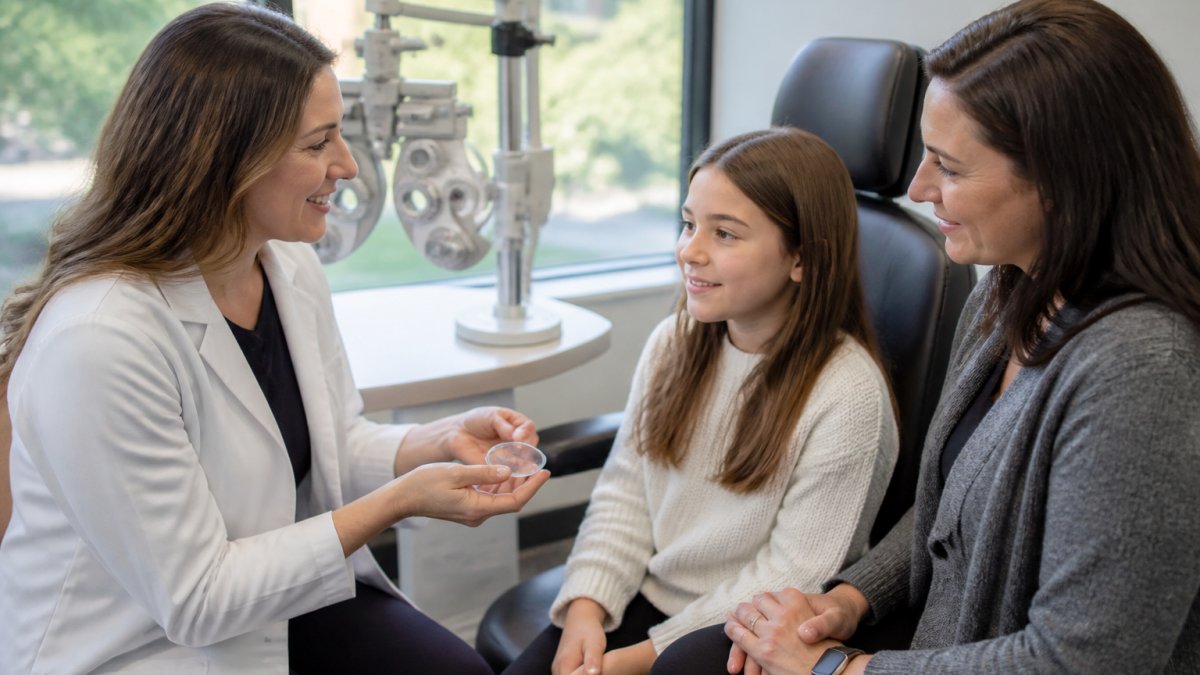
Start by answering these questions:
1. How fast is myopia progressing? Rapid progression suggests stronger interventions like multifocal contact lenses or atropine. Slower progression may respond well to myopia control glasses combined with lifestyle changes.
2. What's your child's age and maturity level? Children under 8 typically do better with glasses.
3. How much near work and screen time is typical? High screen time suggests contact lenses or atropine, which work independently of device wear.
4. Does your child have an active lifestyle? Sports and outdoor activities favor contact lenses or atropine. Glasses can slip or break during physical activity.
5. Is your child responsible with daily routines? Contact lenses require consistent care. Atropine requires daily drops. Glasses are simplest to manage but less effective.
| Decision Factor | Myopia Control Glasses | Multifocal Contact Lenses | Low-Dose Atropine |
|---|---|---|---|
| Age suitability | 6+ years | 8+ years | 6+ years |
| Effectiveness | 25-40% reduction | 40-50% reduction | 50-60% reduction |
| Daily responsibility needed | Low | High | Moderate |
| Best for rapid progression | Moderate | Yes | Yes |
| Best for active children | Moderate | Yes | Yes |
| Easiest to manage | Yes | No | Yes |
Most families find a staged pathway works well: start with myopia control glasses, then add atropine drops or transition to contact lenses if progression continues.
At Corner Optical, we work with families to build myopia management plans that fit real life.
Your first step is a comprehensive eye examination with detailed axial length measurement.
Childhood myopia progression doesn't have to mean your child's prescription doubles by age 16.
Frequently Asked Questions
What is the best myopia control treatment for children?
There is no single 'best' treatment because effectiveness depends on your child's age, prescription strength, progression rate, and lifestyle. Myopia control glasses work well for children who wear them consistently and have moderate progression. Multifocal contact lenses suit older children or teens who can handle lens care responsibly. Low-dose atropine drops show strong results across age groups but require nightly application. Many eye-care professionals recommend starting with the option your child will actually use consistently, then adjusting if progression continues.
How often should a child have follow-up visits during myopia control treatment?
Ongoing monitoring is typically recommended every 3-6 months to confirm the treatment is slowing progression. Children with rapid progression may need visits every 6 months to monitor effectiveness and adjust treatment if needed. Initial visits typically occur 4 to 6 weeks after starting treatment to ensure proper fit and tolerance. Regular monitoring helps catch changes early and confirms whether the chosen treatment is slowing progression as intended.
Are myopia control glasses or contact lenses better for kids?
Myopia control glasses for children are easier to manage and require no daily care, making them ideal for younger children or those new to vision correction. Multifocal contact lenses typically work faster at slowing progression but demand maturity and consistent handling. Contact lenses also offer a wider field of vision and work well for active children. The better choice depends on your child's age, responsibility level, and how much their myopia is progressing. Many families start with glasses and transition to contacts as their child matures.
How does low-dose atropine compare with myopia control lenses?
Low-dose atropine for myopia shows strong slowing of progression across all ages and requires only nightly drops, making it simple to use. However, it can cause mild side effects like light sensitivity and blurred near vision. Myopia control lenses (glasses or contacts) work directly on how light focuses on the retina and have no systemic side effects. Some families use both together for faster results when progression is severe. Your eye-care professional can help determine which approach, or combination, fits your child's needs and tolerance.