 blog
Best Glasses for Narrow Bridge: Fit Guide
Table of Contents
- Understanding Low Bridge vs. Narrow Bridge Fit
- How Nose Bridge Shape Affects Glasses Fit
- Low Bridge Fit Glasses: Key Features and Design
- Glasses for Small Faces: Frame Width and Bridge Measurements
- Adjustable Nose Pads Glasses: Why They Matter for Narrow Bridges
- Glasses That Don't Slide Down Nose: Frame Stability Solutions
- Measuring Your Bridge: At-Home Fit Check and Frame Selection
- Professional Fitting and Adjustments for the Best Fit
- Frequently Asked Questions
Last Updated: October 5, 2026
Understanding Low Bridge vs. Narrow Bridge Fit
The difference between a low bridge and a narrow bridge comes down to where your nose sits relative to your face. A low bridge means the bridge of your glasses rests lower on your nose, closer to the tip. A narrow bridge refers to the actual width of the nose bridge itself, which is smaller than standard frame sizing assumes. The two issues require different frame solutions. (Source: the American Optometric Association's guidelines on proper eyewear fitting)
At Corner Optical, we work with patients who struggle with both fit problems. Frames are engineered with standard bridge widths and heights in mind, so when your nose doesn't match those assumptions, glasses slip, pinch, or sit unevenly. Understanding which issue applies to you is the first step toward finding frames that stay in place.
Low bridge fit affects how the frame contacts your nose: if your bridge is lower, standard frames sit too high, leaving gaps between frame and skin. Narrow bridge fit is about the measurement itself, the distance between the inner edges of the frame where it crosses your nose. Both problems can exist independently or together, so proper diagnosis matters before you buy.
How Nose Bridge Shape Affects Glasses Fit
Your nose bridge shape determines where frames rest on your face and how stable they'll be throughout the day. The bridge is the area between your eyes where the frame makes contact; if it's flatter or lower than average, standard frames won't grip securely.
Frame fit depends on three factors: the bridge width measurement, the height at which the bridge sits on your nose, and the shape of the bridge itself. A flat bridge needs frames with a lower resting point and often requires adjustable nose pads for stability. A higher, more pronounced bridge may need wider bridge measurements to avoid pinching.
The shape of your nose bridge also affects nose pad contact. If your bridge is very flat, traditional pads may touch at only one or two points instead of distributing pressure evenly, creating discomfort and contributing to glasses slipping down throughout the day.
Cheekbone height plays a role too. People with higher cheekbones often have lower nose bridges: the frame must sit lower to clear the cheeks, but a low nose bridge means it won't have enough contact to stay in place without additional support.
Low Bridge Fit Glasses: Key Features and Design
Frames designed for low bridge fit have specific engineering differences from standard frames. The bridge sits lower on the frame itself, and the nose pad placement is positioned to contact a lower point on your nose.
Low bridge fit frames also feature contoured bridges that match flatter nose shapes. Instead of a straight bridge, they have a subtle curve that follows the natural contour of a low nose bridge, allowing fuller contact for better stability and comfort.
Adjustable nose pads are almost always included on low bridge fit frames. They move up or down, forward or backward, to find the exact contact point on your nose, which is essential because a low nose bridge varies in height from person to person.
Material choice matters for low bridge fit. Metal frames with adjustable nose pads offer the most flexibility; plastic frames work but are less adjustable unless they have built-in nose pad systems.
Frame width also affects low bridge fit. Narrower overall widths work better because they reduce the distance the frame spans across your face; a frame that's too wide sits higher, defeating the purpose of a low bridge design.
Glasses for Small Faces: Frame Width and Bridge Measurements
When you have a small face, standard frame measurements often don't fit properly. Frame width, bridge width, and temple length all need to align with your facial proportions. Many people with small faces also have narrow bridges, which compounds the fitting challenge.
Frame width is measured in millimeters and refers to the total width of the frame from the outermost edge of one lens to the outermost edge of the other lens. Standard adult frames range from 130mm to 145mm. For small faces, you'll typically need frames in the 120mm to 135mm range. Some specialty frames go as small as 110mm to 115mm.
Bridge width is the measurement across the bridge of the frame itself, the part that sits on your nose. Standard bridge widths range from 16mm to 22mm. For narrow bridges, you'll want measurements between 14mm and 16mm. Some specialized frames offer bridge widths as small as 12mm.
Temple length, the arm of the frame that goes over your ear, also matters for small faces. Standard temple lengths are 140mm to 150mm. Smaller faces typically need temples between 130mm and 140mm. If temples are too long, the frame will slide down and sit crooked on your face.
The relationship between these three measurements determines whether a frame will fit. A frame that's narrow overall but has a wide bridge won't work, and one with the right bridge width but temples that are too long will still slide. All three measurements must work together.
Adjustable Nose Pads Glasses: Why They Matter for Narrow Bridges
Adjustable nose pads are the most important feature for anyone with a narrow bridge or low bridge fit needs. Unlike fixed pads molded into plastic frames, they can be repositioned to match your specific nose shape and position.
Adjustable nose pads come in different materials. Silicone pads provide comfort and grip. Metal pads with rubber or plastic tips offer durability and precise positioning.
The adjustment mechanism allows you to move pads up, down, inward, or outward. This flexibility means you can fine-tune the contact point until the frame sits exactly where it should on your face.
Adjustable pads also correct frame tilt.
The thickness of the nose pad matters for narrow bridges. Thicker pads provide more surface area for contact, which improves stability, and since a narrow bridge has less surface area overall, maximizing that contact point becomes more important.
Professional adjustment of nose pads makes a significant difference. At Corner Optical, our team can adjust pads precisely to match your nose shape, ensuring maximum comfort and stability.
Glasses That Don't Slide Down Nose: Frame Stability Solutions
Glasses that don't slide down require proper bridge fit, correct nose pad contact, and frame design that matches your face shape. Sliding typically means the frame isn't making sufficient contact with your nose to stay in place.
Frame material affects stability. Metal frames with adjustable nose pads offer the most control over fit. Titanium and stainless steel frames are lightweight, which reduces downward pressure on your nose and helps frames stay in place longer.
Nose pad shape influences stability too. Slightly curved or contoured pads make better contact with a curved nose bridge, while flat pads work for pronounced bridges but may slip on flatter noses.
Temple fit also prevents sliding. If the temples are too loose behind your ears, the entire frame can shift forward and down. Temples should fit snugly without pinching.
Wraparound frame styles naturally prevent sliding better than traditional frames. The curved shape of wrap frames creates more contact points with your face, improving stability.
Some people benefit from temple tips that hook over the ears more securely. These curved tips grip behind your ears, anchoring the frame and preventing forward movement, especially if you're active or outdoors where frames might otherwise shift.
Measuring Your Bridge: At-Home Fit Check and Frame Selection
You can measure your nose bridge at home using a flexible ruler or measuring tape. This helps you identify which frames will fit and guides your selection when shopping for glasses for narrow bridge fitting.
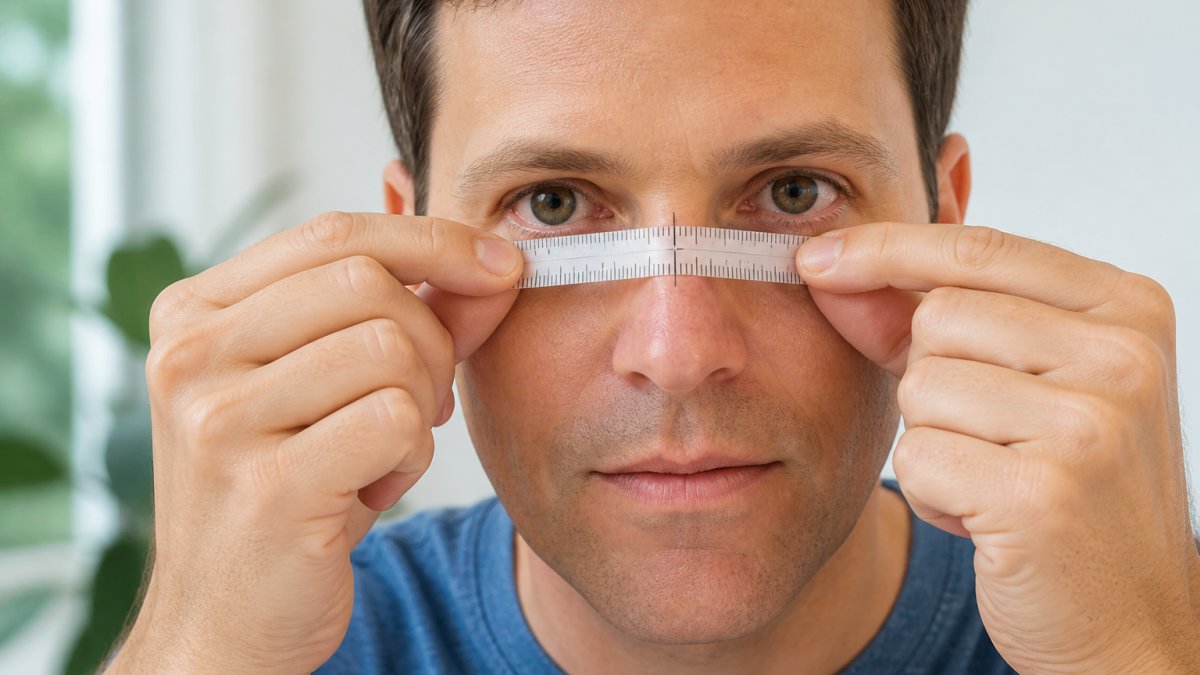
Start by finding the inner corner of your left eye where it meets your nose. This is where the bridge of your glasses will rest. Measure horizontally across to the inner corner of your right eye.
Next, measure your overall face width. Measure from the outermost part of your left eye socket to the outermost part of your right eye socket. This tells you what overall frame width will work for your face.
Measure your temple length by placing a ruler from the outer corner of your eye back along your temple to where it would end behind your ear. This measurement guides your temple length selection.
Document your measurements in writing.
The at-home fit check also means assessing how your current frames sit. Do they slide down, sit too high, or pinch your nose?
Professional Fitting and Adjustments for the Best Fit
Professional fitting at an optical shop provides adjustments and expertise that you can't achieve at home.
During a professional fitting, the optician examines how frames sit on your face, checking bridge fit, temple fit, and overall balance.
Professional adjustments are more precise than DIY ones.
At Corner Optical, our team specializes in fitting frames for challenging face shapes, including narrow bridges and low bridge fit needs. We use our in-house Optical Kitchen to create custom adjustments and modifications.
Professional fitting also ensures your prescription is properly positioned in your lenses. If your frame sits at the wrong angle or height on your face, your prescription won't work optimally.
Return policies matter for fit issues. If you buy frames online and they don't fit, you need a straightforward return process; many retailers have generous windows, but shipping costs add up.
Finding glasses for narrow bridge fit requires understanding the difference between bridge width and bridge position, measuring your face accurately, and selecting frames engineered for smaller nose bridges.
Corner Optical specializes in fitting glasses for complex face shapes, including narrow bridges and low bridge fit needs.
Frequently Asked Questions
What is a low bridge fit eyeglass frame?
A low bridge fit frame is designed for people whose nose bridge sits lower on the face or is flatter than average. These frames feature a higher resting point on the nose, with nose pads positioned higher up the frame. This design prevents glasses from sliding down and ensures the lenses sit at the correct distance from your eyes for optimal vision and comfort. Low bridge fit frames typically have bridge widths of 14-16 mm, compared to standard frames at 17-21 mm.
How can I tell if I have a narrow bridge versus a low bridge fit issue?
A narrow bridge means the distance between your eyes is smaller, requiring a narrower bridge width measurement. A low bridge means your nose bridge sits lower or flatter on your face. To determine which applies: measure the distance between your pupils (pupillary distance) and the width of your current frame's bridge. If your glasses slide down, the bridge may be too wide or positioned too low. If the bridge feels tight or pinches, you likely have a narrow bridge. Professional fitting can clarify both issues and identify the right frame specifications for you.
What frame features help glasses stay secure on a narrow bridge?
Key features include adjustable nose pads that can be repositioned higher, contoured bridge designs that wrap more securely around the nose, and materials like titanium or flexible plastic that conform to your face shape. Frames with higher resting points prevent sliding, while thicker or cushioned nose pads reduce pressure and improve grip. Temple length also matters: if temples are too long or short, they affect how the frame sits. Ridge-style nose pads with deeper grooves provide better stability than flat pads.
Can an optician adjust glasses that don't fit my narrow bridge?
Yes, many adjustments are possible. An optician can reposition nose pads higher, bend temples for a better fit, or adjust the overall frame shape. However, if the frame's bridge width is fundamentally too wide, adjustments have limits. This is where professional fitting becomes valuable: an optometrist or optician can assess your specific needs, recommend frames with the right measurements, and make precise adjustments to ensure comfort and proper lens alignment for clear vision.