 comparison
Handmade Frames vs Mass Produced Glasses
Table of Contents
- Handmade Frames vs Mass Produced Glasses: The Core Differences
- How Eyeglass Frames Are Made: Handmade vs Industrial Production
- Understanding Handmade Eyeglass Frames
- Mass-Produced Glasses: Consistency and Accessibility
- Handmade Glasses Cost: What You'll Actually Spend
- Quality, Fit, and Long-Term Value
- How to Verify a Frame Is Genuinely Handmade
- Which Option Is Right for You?
- Frequently Asked Questions
Last Updated: October 11, 2026
Handmade Frames vs Mass Produced Glasses: The Core Differences
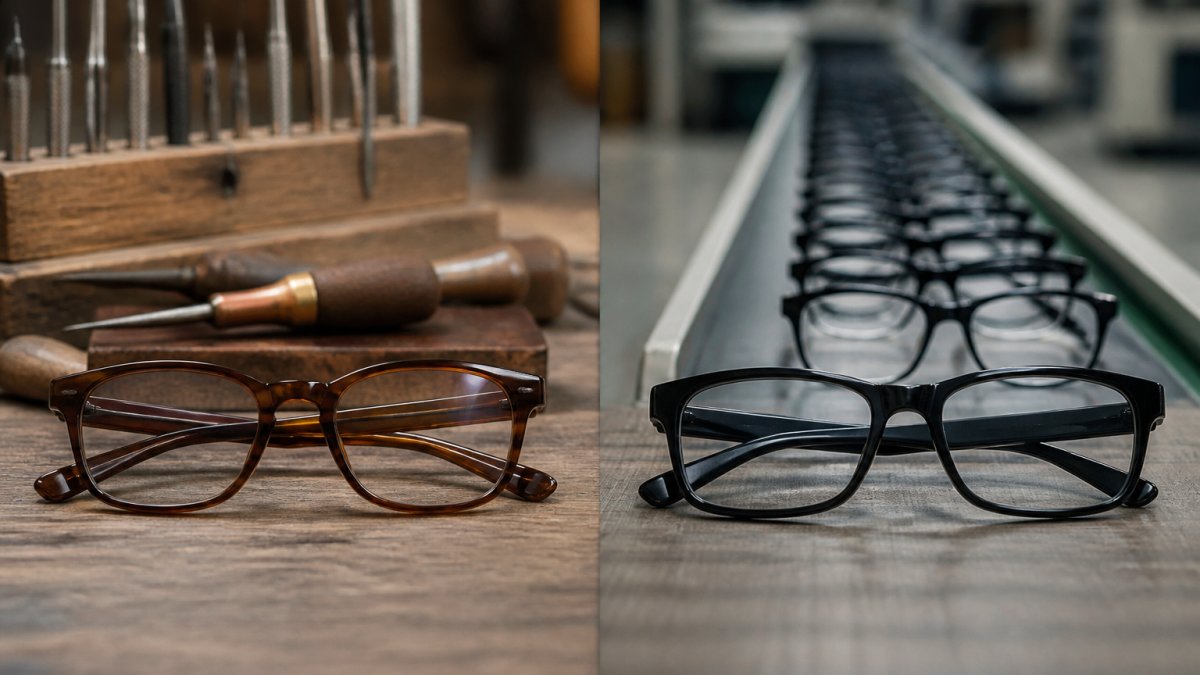
When you're choosing eyeglasses, the manufacturing process behind your frames matters more than most people realize. Handmade frames vs mass produced glasses represent two fundamentally different approaches to eyewear creation, each with distinct trade-offs in customization, durability, cost, and fit.
Handmade frames are created through manual processes where artisans shape acetate or metal materials in small batches. Mass-produced glasses use injection molding, die casting, and automated assembly on standardized production lines. At Corner Optical, we help you understand which approach aligns with your vision needs and lifestyle.
How Eyeglass Frames Are Made: Handmade vs Industrial Production
The manufacturing process is where handmade frames and mass-produced glasses diverge most sharply. Understanding these differences helps explain why one costs more, why one customizes better, and why durability varies.
Handmade Frame Production
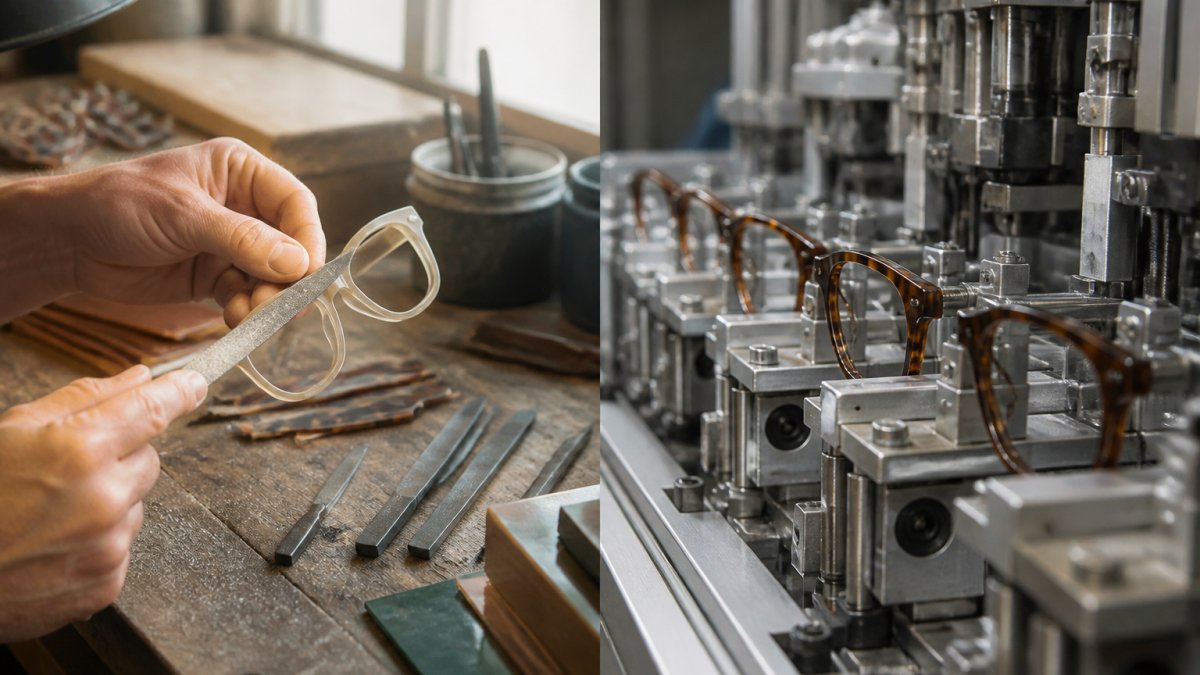
Handmade frame production relies on skilled artisans to hand-cut and shape acetate or metal, then individually finish and assemble each frame. Frame components are shaped individually rather than stamped from a mold. Finishing, sanding, polishing, and painting, is done carefully to achieve desired surface quality and color depth. Each hinge, screw, and lens-setting component is fitted together with precision adjustments.
This approach allows artisans to adapt frames during production. If a prescription requires a specific bridge width or temple length, the maker can adjust the acetate to fit.
Mass Manufacturing Processes
Mass production uses injection molding or die casting to force molten plastic or metal into precise molds, creating frame components in seconds. Frames then move through automated assembly lines where machines insert hinges, apply coatings, and perform quality checks. Production speeds reach hundreds or thousands of frames per day from a single mold.
Each frame from a given mold is identical in dimensions, weight, and construction. Quality control uses sampling and automated testing, keeping costs low. The trade-off is inflexibility: changing design requires new tooling, a significant expense. Mass-produced frames come in limited sizes and styles, with customization beyond color or lens type rarely possible.
Understanding Handmade Eyeglass Frames
Handmade frames appeal to people who value customization, unique design, and the story behind their glasses. But handmade doesn't automatically mean better, it means different.
Materials and Craftsmanship
Handmade frames typically use premium acetate or high-quality metals sourced for color depth and stability. Hand-cutting allows artisans to work with thicker, more durable acetate sheets that are harder to mold at scale.
Hand-polishing creates depth and luster that injection-molded frames lack. Colors in handmade acetate frames are richer because the material avoids the heat and pressure of injection molding. Metal frames allow thinner, more delicate designs, and hinge construction is stronger because each component is individually fitted and adjusted.
Customization and Design Flexibility
Handmade frames excel at customization. If your prescription requires a specific bridge width or your face shape doesn't fit standard sizes, an artisan can adjust the frame to match your exact needs. You can choose custom colors, finishes, and design modifications.
Durability and Repairability
Handmade frames often last longer due to quality materials and careful assembly. Repairability is a major advantage: broken hinges or cracked temples can usually be repaired. Mass-produced frames with glued or welded components are often discarded when damaged because repair costs approach replacement.
Mass-Produced Glasses: Consistency and Accessibility
Mass production isn't inferior, it's optimized for different priorities: affordability, availability, and consistency. For many people, these matter more than customization.
Standardization and Quality Control
Mass-produced frames are identical, with predictable performance. Quality control uses statistical sampling and automated testing to verify standards like ANSI Z87.1 (impact resistance for safety). This catches systematic problems before thousands of defective frames reach retailers, with individual frame variation staying within tight tolerances.
Speed and Scale
Mass production delivers frames quickly at scale. Retailers stock multiple sizes and colors because production cost per frame is low. Manufacturers producing millions of frames annually spread tooling and overhead costs across many units, making mass-produced frames significantly cheaper than handmade alternatives. For people on tight budgets or those needing glasses quickly, mass production is the practical choice.
Handmade Glasses Cost: What You'll Actually Spend
Cost is often the deciding factor. Handmade and mass-produced frames operate in different price ranges, and understanding why helps you make a realistic choice.
Price Drivers for Handmade Frames
Handmade frames cost more due to labor, material quality, and production volume. An artisan's time is expensive, with shaping, finishing, and assembly all done manually. Handmade producers source premium acetate or specialty metals, and a maker producing 50 frames per month spreads overhead across fewer units than a factory producing 50,000.
According to View Eyewear's luxury eyewear guide, hand-finished optical frames in limited production runs start around $985, with core models ranging from $985 to $1,385. These represent the high end of handmade production, artisanal makers in Japan and Italy creating frames in small batches.
Not all handmade frames cost this much. Local artisans or smaller workshops may charge less, though pricing still reflects the labor-intensive process.
Mass-Produced Frame Pricing
Mass-produced frames are typically more affordable. The price difference reflects production economics: factories producing many frames annually spread tooling costs across many units, with machines handling most work. For most people, the price difference is substantial enough to influence the decision. If budget is limited, mass production is the practical choice. (Source: consumer spending trends on eyewear)
Quality, Fit, and Long-Term Value
Price alone doesn't determine value. You need to consider durability, fit accuracy, and how long the frames will serve you.
Fit and Prescription Accuracy
Poorly fitting glasses cause headaches, slipping, and discomfort. Mass-produced frames come in standardized sizes; if your face shape doesn't match, you accept compromises. Handmade frames can be adjusted to your exact measurements, bridge width, temple length, and lens shape. For people with narrow bridges, wide faces, or asymmetrical features, this flexibility is transformative.
Prescription accuracy is another consideration. Complex prescriptions, high astigmatism, significant sphere power, or bifocals, sometimes require custom lens positioning. A handmade frame allows the optician to position lenses exactly where your prescription demands. Mass-produced frames have fixed lens positions, which works for most prescriptions but can be limiting for unusual ones.
At Corner Optical, we assess whether your prescription and face shape benefit from custom fitting. Sometimes a well-chosen mass-produced frame works perfectly. Other times, the precision of a handmade approach makes a real difference in vision quality and comfort.
Durability and Lifecycle Cost
Handmade frames often last longer. Quality materials, careful construction, and attention to weak points mean fewer failures. A handmade frame might last longer with normal use. Mass-produced frames typically last a shorter period before a hinge breaks, a temple cracks, or coating degrades.
Repairability affects lifecycle cost. A handmade frame with a broken hinge can be repaired. A mass-produced frame with a broken hinge often costs more to repair, sometimes approaching the cost of a new frame, which makes replacement the rational choice.
Over a 10-year period, the total cost of ownership might actually favor handmade frames despite higher initial cost. If you wear the same pair daily, durability compounds the savings.
However, this calculation changes if you prefer variety. If you like owning multiple frames and rotating them, mass production's lower cost makes sense. You can afford three or four pairs of mass-produced frames for the price of one handmade pair, and replacing them every few years isn't a financial burden.
How to Verify a Frame Is Genuinely Handmade
Not every frame labeled "handmade" is actually made by hand. Some manufacturers use the term loosely to justify higher prices. Here's how to verify authenticity.
Genuine handmade frames have maker marks or signatures. Look for the artisan's name, initials, or workshop mark on the frame. This accountability matters, a maker who signs their work has reputation incentive to maintain quality.
Ask about production volume. A true handmade maker produces frames in small batches, typically 10 to 50 per design per month.
Request information about the shaping and finishing process. Ask whether the frame shape comes from a mold (mass production) or is hand-shaped (handmade). Ask whether finishing is done by hand or machine.
Check for consistency. Handmade frames have subtle variations, slight differences in color depth, texture, or finish between individual frames. Mass-produced frames are identical.
Ask about customization capability. True handmade makers can adjust bridge width, temple length, or design elements for your specific needs.
Which Option Is Right for You?
The choice between handmade frames and mass-produced glasses depends on your priorities, budget, and how you use your glasses.
Choose handmade frames if:
Your face shape or prescription is complex and doesn't fit standard sizes. You value unique design and want glasses that reflect your personal style. You wear the same pair daily and want frames that last a decade or longer.
Choose mass-produced glasses if:
Your face shape and prescription fit standard frame sizes comfortably. You prefer affordability and want to own multiple pairs. You like having new styles available quickly. You're comfortable replacing frames every 3 to 5 years.
Consider a hybrid approach:
Many people benefit from owning both. A handmade frame as your primary pair, customized for fit and durability, paired with a mass-produced backup pair for travel or active situations.
At Corner Optical, we help you evaluate both options through our comprehensive eye exams and frame consultations. Our Optical Kitchen allows us to create bespoke eyewear tailored to your prescription and face shape.
The choice between handmade frames and mass-produced glasses isn't about which is objectively better, it's about which aligns with your needs. Understanding the trade-offs helps you invest in eyewear that you'll actually wear and enjoy. ANSI standards for eyewear impact resistance establish safety requirements that both handmade and mass-produced frames must meet, so quality and safety don't depend on production method alone.
Frequently Asked Questions
Are handmade eyeglass frames better than mass-produced frames?
Neither is universally better, it depends on your priorities. Handmade eyeglass frames typically offer superior customization, adjustability, and hand-finishing that mass-produced glasses often can't match. However, mass-produced frames deliver consistent quality control, wider style options, and affordability. If you have a complex prescription, unusual facial structure, or value one-of-a-kind design, handmade frames excel. If you need quick replacement or prefer standardized sizes, mass-produced options are more practical.
Do handmade glasses last longer than mass-produced glasses?
Handmade frames generally offer better longevity because they use higher-grade materials and hand-finishing techniques that reduce weak points. They're also easier to repair, a skilled optician can adjust, reshape, or replace components. Mass-produced frames are engineered for durability too, but standardized assembly sometimes creates stress points. The real difference is repairability: a handmade frame can often be restored to like-new condition, while mass-produced frames may be harder or impossible to repair economically.
What makes handmade glasses cost more?
Handmade glasses cost more because of labor intensity, material selection, and small production runs. Each frame requires hours of skilled hand-shaping, finishing, and quality inspection. Artisans often source premium acetate or specialty metals rather than bulk commodity materials. Limited production means no economy of scale. Mass-produced frames spread labor and tooling costs across thousands of units, making per-unit cost much lower. Handmade production also typically involves domestic or regional manufacturing rather than overseas mass manufacturing.
How can I tell if eyeglass frames are truly handmade?
Look for these indicators: the manufacturer clearly states handmade production and limits annual output; frames show visible hand-finishing marks or natural material variation; the optician can describe the specific production process; the brand offers extensive customization options; and there's documentation of where and how the frames are made. Beware of vague marketing claims. Genuine handmade producers often provide transparency about their artisans, workshop location, and materials. Ask your optician directly about production methods and request details about the frame's origin and craftsmanship.
Should I choose handmade or mass-produced glasses?
Choose handmade frames if you have a complex prescription, challenging facial structure, specific style vision, or value customization and longevity. Choose mass-produced frames if you need affordability, quick turnaround, a wide range of standard sizes, or easy replacement. Many people benefit from a professional fitting consultation, an experienced optician can assess your prescription complexity, facial geometry, and lifestyle to recommend the best approach. Corner Optical's Optical Kitchen specializes in custom handcrafted frames for patients with unique needs.